Posts
Posts


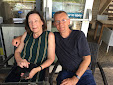
John and I arriving at Latimer Road Station with Grenfell Tower in the distance.
In the past, a good friend of mine, John and I had talked about visiting the site of Grenfell Tower to see where the conflagration happened. It is easy to think we might have been spectators out of morbid interest. I think we wanted to get a sense and understanding, if that is possible.
John and I worked out a route to Grenfell via the Circle Line from Wimbledon. We both got our separate trains to Wimbledon Station then the District Line. It’s always interesting to travel a route we seldom travel. It’s a few years since I took this line. Through Putney, across the Thames on through Fulham Broadway to Earls Court. We changed at Earls Court to take the branch line to Hammersmith, with its music and theatre history. I saw The Who at Hammersmith Odeon when I was 19 years old. John and I had a coffee in a shop outside of the station. From there we walked to the Hammersmith and Circle Line station which took us to Latimer Road. We got out of the train and there, nearby, we both got our first view of Grenfell Tower dressed in its white cladding and giant green hearts.

Grenfell Tower from the roads around.
It was reasonably easy to find the site of the tower which is now a ,”deconstruction,” site with a crane overarching it and site workers in hard hats busy with its gradual demolition. One road to it was barred by gates and fences. A friendly and understanding site worker said our route was barred to pedestrians now. We wanted to find the memorial garden and he directed us in the direction we needed to walk.

Teresa May visiting Grenfell the day after the disaster.
I have a flickering memory of seeing this on the news on the day of the tragedy. These same streets full of firefighters , hoses and fire engines, search lights lighting up the vicinity. At the time Theresa May was the Prime Minister. She visited the sight the day after the tragedy to meet with firefighters and the police. A picture shows her standing amongst a group of firemen ,a fireman explaining what had happened his arm pointing and Theresa may looking up in the direction he pointed. What she did not do is meet with any of the survivors which she has been strongly criticized for. She herself regrets not doing that. She has met survivors since. She quickly announced a full inquiry and stated then that the people of Grenfell Tower had been failed . Already those in authority knew it was their failings. Years of government cutbacks and a failure to keep to strict building and construction standards. I have read the report which is available free online from the National Archives all these nine years later. It confirms in great detail many of the failings that people knew about then.

John and I walked the streets, Whitchurch Road, Treadgold Street, Grenfell Road, Sirdar Road. We walked past St Clements Church. We stood on the steps and of the forecourt to Kensington Leisure Centre near the tower. We looked at the Kensington Aldridge Academy close to the Tower and entered the basement of the low level flats in Whitchurch Road and talked to the security guard on duty in the entrance. These places were crucial to what happened as the fire unfolded and in dealing with the aftermath of the disaster.

Kensington Leisure Center next to the tower.
The inquiry report describes how there was a lack of response from Kensington and Chelsea and in particular the TMO (the Tenant Management Organisation). Lack of trust, lack of communication and future planning all failed the occupants of Grenfell and it was places such as St Clements Church nearby that was used as a drop in centre and a warehouse for resources the tenants needed in the aftermath that came to the fore. The Kensington Leisure Centre was the main emergency relief centre. It was initially chaotic because of the lack of any organisation by the council. Kensington Aldridge Academy the secondary school within the shadow of Grenfell ,had to be evacuated and closed down. It was placed in temporary accommodation for a year until it could return to its premises.

The entrance to Baseline Business Studios.
John and I went down the steps into the cavernous basement area to the flats near Grenfell. It is now a vibrant hub of workshops and local businesses, a collective called Baseline Business Studios. A poster in a window read ,”Your Home, Your Community, Your Area.”
It is a local office space and enterprise space that supports economic growth for local start ups. There are various occupation categories including local businesses, community organisations, council services and commercial enterprises. Some of the startups include Lancaster West Neighbourhood Team, part of the housing management that was established in 2018 after the fire in response to the Grenfell tragedy. It provides an open front door for residents who have any queries. This was a service that Kensington and Chelsea had certainly not provided for the tenets in the past. Another company is Red TV Management that includes a design group. Hand Painted Ceramics is run by Suzanna KatKhida. The north Kensington Law centre is here. V Plus V Internal is an architecture group that also designs furniture. United Living Property Services provides property services such as regeneration, building maintenance and building safety. Ther are up to forty different businesses in this basement area.I presume resources and finance were provided for these things after the fire to help regenerate Grenfell.

One of the high level walkways near Grenfell Tower.
John and I walked along some of the high level concrete walkways that connect the local low level flats in our exploration of the area around the tower. At one location we were so close to the weather sheeting that cover the tower we could almost reach out and touch it. People are living in these flats connected by these walkways. Grenfell is constantly in their minds and in their vision. What memories and experiences these people have we can only surmise. We saw local residents walking along the same walkways John and I walked along. It would have been insensitive to speak to people about what happened. John and I felt acutely aware of where we were and what happened here. I wonder now what they must have thought of us walking about. They would know we weren’t locals.

For a while we stood in the area beside the tower that is a memorial garden. There are photographs of people who died and tributes to them. There are large green and red hearts with the word ,Grenfell, in the centre. Large white areas of wall are written on by local people and survivors remembering various individuals. Teenagers, I guess from Kensington Aldridge Academy, have written poems.
I will use the title and spellings of the displayed poems.
Here are parts of three poems.
Regeia Yasin 14 years of age wrote.
REMEBERING GRENFELL : A Promise For Justice.
“Hi everyone.
Today we are here to remember Grenfell
And more importantly the people we lost
…………………………….
They weren’t just victims of a fire
They were failed by a system that should have protected them
……………………………….
…….the people in that tower deserved so much better”
Karnis Julian 14 wrote.
(This brought tears to my eyes.)
“My Life After That Day.
It has been 8 years since there
Has been a hole in my heart
…………………………..
We saw our parents crying.
Life changed that day.
I remember after that day I was worrying if my best friend Taleen was still alive
I started to go to therapy
…………………………………….
My life after that day became scary.”
Taleen Ahmed 14 years old wrote.
“SEVENTY TWO
Seventy two. We speak each name
Seventy two with lives unfinished
………………it was cut by greed and those who lied
………………ignored the vulnerable.”

John and I stood in silence for a minute and then said a prayer to the dead and the bereaved.
Then we read some of the handwritten comments on the white areas where many have written their thoughts.
This is what some wrote.
“ This should never happen again. RIP.”
“Burning is his way. X Partner forever Bev.”
“Love & never forgotten ever. My only wish is to turn back time.”
“To see you again. See you on the other side.” RIP Ray and Karen.
“Heartbroken. Took Marley.”
“Forever in our hearts.”

The comments go on and on. There are masses of them. A whole web of thoughts and feelings. It’s heartbreaking seeing them written with love and pain. A catastrophic event like Grenfell will affect individuals, families, friends the community forever. It will always be there.
Grenfell Tower was built in 1974 two years after Trellick Tower a few miles away. The fame attached to each of them could not be more different. Trellick is a design icon, a listed building with literary and film history attached to it. It is a 1970’s historic gem.
Grenfell Tower burned down on the 14th June 2017 killing 72 people and making hundreds homeless.
The next day the Prime Minister, Theresa May set up a public inquiry into the disaster.
In the introduction to the first part of the inquiry report it states,
“On the morning after the fire the Prime Minister announced that there would be a public inquiry into the circumstances surrounding the fire and on 28 June 2017 I was appointed to act as its chairman. On 15 August 2017 the Inquiry was formally set up under the Inquiries Act 2005 (the Act);”

A memorial wall.
The inquiry was lead by The Rt Hon Sir Martin Moore-Bick. One of the thoughts that always occurs when an inquiry like this is set up is has the right choice of person to lead the inquiry been made? The government, the nation as a whole and certainly the people of Grenfell want somebody who is going to carry out a thorough inquiry that leaves nothing unexamined.
Was Sir Martin Moore Bick the correct person to carry out this inquiry?
The Guardian published an article explaining there were doubts about his suitability.
“Educated at the Skinners’ school in Tunbridge Wells and at Christ’s College, Cambridge, he became a barrister in 1969 and spent more than 20 years as a judge of the commercial court and the court of appeal. There were reports that there had been a delay in announcing his appointment because of concerns in Downing Street over his record on the bench.
In one 2014 case, Moore-Bick said Westminster council could rehouse Titina Nzolameso, a single mother with five children, more than 50 miles away in Milton Keynes. He ruled that it was not necessary for Westminster to explain in detail what other accommodation was available and that it could take “a broad range of factors” into account,” including the pressures on the council, in deciding what housing was available.
In light of this, how would he treat the tenants of Grenfell?
I have read most of the report. It is more than 2500 pages long. I read the introductions and conclusions to the different volumes that constitute each of the two parts. Some of the chapters I have read in more detail . In particular the parts about how the construction and building trade constructed their cladding and how it was tested and given British Standards approval.
The tone is detached, dealing with facts and assessments of the evidence but it is written in an accessible language that is not too technical and can be read and understood by any person. It also has a sensitivity towards the people of Grenfell. You get a sense that Sir Martin Moore Blick is on the side of the people of Grenfell and he is doing his very best for them. I have found no criticism of him and his report from the people of Grenfell.
I will try and provide an overview of what the report says. I have been left gasping, shocked and annoyed. I felt angry reading it.
I think the report provides a view in microcosm of how our country in many aspects is governed. Everywhere you look there are failures which affect us all.
The Grenfell Report reveals many failures but I would like to begin with the relationship the people of Grenfell Tower had with the local authority, The Royal Borough of Kensington and Chelsea known as RBK in the reports. The council gave any dealings with people in social housing to what is termed the TMO, the Tenant Management Organisation. The TMO had lost the trust between itself and the people of North Kensington. They had ignored complaints about the need for repairs for years. They saw certain individuals who lead the many complaints as the enemy. The TMO had no real plans in place to deal with any disasters that might occur. The poorly designed plan they had was inadequate. The Royal Borough also had a plan but it too was inadequate and was long out of date and there was no communication or links between it and the TMO. Local government buildings regulation officers lacked experience and training.
The London Fire brigade, perhaps through lack of funding over years had inadequate training and inadequate resources to deal with anything on the scale of Grenfell. They couldn’t deal with the large number of 999 calls from people located in the flats and often they could not interpret the information they were being told. There was also a lack of communication with firefighters and other organisations on the ground. The LFB also were working on plans that had been created fifteen years previously before the refurbishment of Grenfell which made their plans useless. The ,”stay put,” policy, the order for people to remain in their flats was fundamentally wrong. When the LFB realised that the, stay put, policy could not work they were slow in changing the approach.

The London Metropolitan Police Force were successful in controlling the area when the fire broke out but much of their key equipment such as the latest helicopter surveillance from the air was being repaired at the time. Helicopters were in the air monitoring what was going on but the equipment’s inadequacies made the surveillance unhelpful.
One fundamental weakness in the response was the lack of communication not only between the LFB’s own call centres with its own firemen but also between the services, the police, the fire brigade and the council itself. Nobody knew what the others were doing in effect. Returning to the police helicopters monitoring of the fire, they could not link their video footage of what was happening with the other services. There was no link in communication . The newer helicopters that were grounded did have the more up to date equipment which would have allowed them to communicate with all the services but they were not in use.
There was of course a fundamental lack of training and planning in all areas. The government at the time, first under David Cameron, who introduced austerity measures and then at the time of Grenfell, Theresa May, who was continuing the austerity approach, was all about cut backs and saving money. The government minister in charge of building rules, regulations and safety was an inexperienced junior minister.
The companies that made the insulation Arconic, who made the rainscreen panels, Celotex, the foam insulation, Siderise, who made the cavity barriers and Kingspar who created a false market in insulation, that had recently been put onto Grenfell tower was probably the greatest cause of death and in creating a disaster. There is a strong argument for criminal proceedings against people who knowingly sold and promoted cladding and insulation they knew was dangerous and inflammable. The testing that had been done on the materials used was inadequate. It was not carried out in realistic situations. The British Standards organisation took the information the companies provided about the materials at face value and passed them for use. They carried out no tests themselves.

The streets and community around Grenfell.
THE FIRE:
The fire began in flat 16 at 2.12 am because of an electrical fault in a large fridge freezer in the kitchen. The people in the flat were Mr Kebede, Ms Afeworki and Ms Kinfin. The occupants were found to carry no blame for what happened. From the kitchen the fire entered the cladding on the outside of the building.
A fire of that relative modest size was perfectly foreseeable by the designers of the flats. The original concrete construction was actually designed to contain a fire within a single flat. This lead of course to London Fire Brigade’s original stay put policy. All the occupants were told to stay within their flats for safety. However, because of lack of updates over the years to the LFBs planning for such a fire in a block like this, that policy no longer pertained.
As we know the flats had been refurbished with flammable materials that were not in the original design. As well as insulation cladding which was attached to the outer walls an aluminium rain shield was placed over the new insulation that itself was also lined with flammable materials. There was a gap between the rain shield and the insulation creating a flu for hot air and flames to pass up the building. The initial fire could possibly still have been contained within the flat itself if other factors had not occurred. Many of the extractor fans in the kitchen areas did not work and often were jammed open to create an air flow. But more importantly the windows now created the biggest hazard. In the refurbishment the windows had been replaced. The new windows were smaller than the original windows and the gap around the new windows had been filled with inflammable materials. The window in flat 16 was the cause of the fire getting from the flat to the outer cladding. Windows in the other flats throughout the block, which failed too, were the cause of the fire entering the flats.
Within twenty minutes the fire had reached from flat 16 to the top of the block up the east face. The top had been decorated with inflammable materials and so it soon continued around the top of the flats before descending down the other three sides burning the aluminium composite rainscreen panels that had polyethylene cores which became a source of fuel. Nothing complied with any sort of robust building regulations.

St Clement with St Marks Church next to Grenfell Tower.
The poor planning by RBKC and the TMO was dire. They had nothing in place to deal with the now homeless people from the flats or dealing with the families of the bereaved. It was local people, local churches and the community centre that dealt with the aftermath.
The London Metropolitan Police have been conducting their own criminal inquiry in parallel to the Government inquiry. This year 2026, nine years after the disaster should be the year we find out if there will be criminal prosecutions. Of course there should be. There were failings in every aspect of running the social housing in the borough. There were failings in every aspect of the construction trade. There were failings in every aspect of the responding organisations. Many people who were part of the council, the fire brigade or the police are not culpable because they were part of failing organisations that was not their fault. The people at the top running these organisations and making unsafe decisions often knowingly should have criminal prosecutions brought against them though.
Since the Grenfell disater the numbers of buildings discovered that need remedying have increased. The honest truth is the authorities do not know how many buldings of 11 meters or below , the lower rise buildings, need putting right. The 18 plus meter buildings, such as Grenfell , the numbers are about five hundred. They say 95% of these have been remedied so far. The governement is talking about the end of 2029 before all 11 meter buildings and lower are put right. There are of course other sorts of flammable cladding that is different from the Grenfell cladding that needs putting right. In some government reports there are statements, almost of desperation, where they wonder if all buildings can be found that need remedying. The thing is of course that standards need to be high for all new builds so the problem isn't increased. The government say this in place.
On reflection, reading about the web of complicity and how many bad decisions all came together I wonder whether what happened at Grenfell is a small example of how our whole country is run?
LONDON FIREBRIGADES RESPONSE
https://www.london-fire.gov.uk/about-us/grenfell-tower-fire/grenfell-tower-fire-news-archive/
BBC NEWS ARTICLES
https://www.bbc.co.uk/news/topics/cnw8ynk633gt
https://www.bbc.co.uk/news/articles/cj9lg4yrpeko
https://www.bbc.co.uk/news/articles/cvg1eje2jg4o
ROYAL BOROUGH OF KENSINGTON AND CHELSEA RESPONSE
https://www.rbkc.gov.uk/grenfell-response-and-recovery/grenfell-tower-inquiry
THE GUARDIAN
https://www.theguardian.com/uk-news/2017/jun/28/grenfell-tower-inquiry-judge-retired-martin-moore-bick
LONDON METROPOLITAN POLICEC RESPONSE TO THE GRENFELL REPORT
https://www.london.gov.uk/who-we-are/what-london-assembly-does/questions-mayor/find-an-answer/grenfell-tower-investigation
https://www.met.police.uk/foi-ai/metropolitan-police/disclosure-2023/october-2023/investigative-information-relating-grenfell-fire-case/
THE GRENFELL INQUIRY REPORT HELD IN THE NATIONAL ARCHIVES
Phase 1 full report in The National Archives
https://webarchive.nationalarchives.gov.uk/ukgwa/20250320040117/https://www.grenfelltowerinquiry.org.uk/phase-1-report
Phase 2 full report in The National Archives
https://webarchive.nationalarchives.gov.uk/ukgwa/20250320032754/https://www.grenfelltowerinquiry.org.uk/phase-2-report
UK GOVERNMENT
https://publications.parliament.uk/pa/cm5901/cmselect/cmpubacc/362/report.html#heading-0