Thursday, 26 May 2016

THE EU REFERENDUM


The Grand Canal. Marilyn and I had a lovely few days in Venice.  Travelling freely around Europe is brilliant.  


On the 23rd June 2016 the people of the United Kingdom will go to their local polling stations and vote on the EU referendum. Do they want the United Kingdom to stay in the European Union or do they want them to leave?

This question has split our political parties.
The Conservatives, who are in government at the moment, lead by David Cameron, are going through the process of a particularly nasty and vicious struggle between members of their own party. UKIP (The United Kingdom Independence party) lead by Nigel Farage, are vociferously cheerleading the exit group. Both the Labour Party and the Liberal Democrats have divided opinions. The in fighting in those two political parties appears to be less destructive than within the Conservative party though. 

A recent series of polls produced by ICM (ICM Research, is a public opinion researcher) for the Guardian reveals that overall, the British public are equally split over the referendum. Phone polling, which is the most accurate form of research because the people  are chosen to be a cross section of society taking into account age, ethnicity, gender, social status, work and location. Internet polling seems to be age biased towards a younger group. With internet polling there is no control over the factors that phone polling can take into account. Internet polling proved to be wildly inaccurate in our last general election. Both polling strategies were used in this recent poll by ICM. It showed that in their phone poll 47% were in favour of remaining in the EU, 39% were in favour of leaving and 14% were undecided. Internet polling showed 43% in favour of remaining, 47% in favour of leaving and 10% undecided. If however you take into account all possible variables the picture looks pretty much as though the British public are split half and half. This is a little worrying because it could go either way. There does not seem a big lean one way or the other which is creating tensions in our economic dealings and indeed it is causing tensions throughout Europe. Businesses do not know where or when to invest. It is hampering growth at the moment. Hopefully this is going to be a short term situation which will be clarified when the referendum has been voted on.

Why is a referendum being held? Our Prime Minister, David Cameron promised to hold a referendum if he won the 2015 general election, in response to growing calls from his own Conservative MPs and the UK Independence Party (UKIP), who argued that Britain had not had a say since 1975, when it voted to stay in the EU in a referendum. The EU has changed a lot since then, gaining more control over our daily lives. Immigration issues, questions about sovereignty, questions about democracy and being in charge of our own economic destiny are all issues being hotly debated connected with this issue. Mr Cameron said: "It is time for the British people to have their say. It is time to settle this European question in British politics."


Emily, Abi and Marilyn enjoying a walk around La Guell, Gaudi's park in Barcelona.
One of my most favourite places to visit in all of Europe.

David Cameron negotiated with the European Council in Brussels and came back to the British people with changes to our membership that he thinks warrant us remaining in the EU because they deal with some of the worries people have in Britain about being members of the EU.


These cover, firstly child benefit. Migrant workers will still be able to send child benefit payments back to their home country - Mr Cameron had wanted to end this practice - but the payments will be set at a level reflecting the cost of living in their home country rather than the full UK rate.


Secondly there is the question of migrant welfare payments. Mr Cameron says cutting the amount of benefits low paid workers from other EU nations can claim when they take a job in the UK will remove one of the reasons people come to Britain in such large numbers (critics say it will make little difference). He did not get the blanket ban he wanted. New arrivals will not be able to claim tax credits and other welfare payments straight away - but will gradually gain the right to more benefits the longer they stay, at a rate yet to be decided.


British people want to keep the pound. Mr Cameron has said Britain will never join the Euro. He secured assurances that the Eurozone countries will not discriminate against Britain for having a different currency. Any British money spent on bailing out Eurozone nations that get into trouble will also be reimbursed.


There is also the question of the large financial sector we have in the City of London. Mr Cameron has negotiated safeguards for Britain's large financial services industry to prevent Eurozone regulations being imposed on it. 


Finally, for the first time, there will be a clear commitment that Britain is not part of a move towards "ever closer union" with other EU member states - one of the core principles of the EU. This will be incorporated in an EU treaty change. Mr Cameron also secured a "red card" system for national parliaments making it easier for governments to band together to block unwanted legislation. If 55% of national EU parliaments object to a piece of EU legislation it will be rethought. Critics say it is not clear if this would ever be used.

 
Robert Clive, Clive of India negotiating with a Moghul.


Britain and trade have always had a close and fruitful relationship. We are an island sea going nation. The ability that Britain had for enormous growth in trade goes back to the late 1600s. Compared to other European countries such as France, Spain and the Netherlands, which were our trading rivals at the time, Britain appeared to have a much larger middle cl,ass which had a facility for commerce and a desire to settle in new continents. They had the education and wealth to get things done. Merchant ships went to North America and the West Indies. The triangular trading system was born. Slaves would be brought from Africa to the Americas to work on the plantations which grew sugar and cotton and other commodities. These were then shipped back to Britain. In turn these commodities boosted the growth of industries for processing the commodities. Ship building, industrialisation, with its accompanying technological inventions and agriculture, which created a parallel revolution, all boosted Britain as a world power and trading nation. To go with this the City of London became a great financial centre financing this growth alongside new developments. The loss of part of the Americas through the American Revolution was a setback but after the Napoleonic Wars when Britain was the victor and France and Spain were defeated Britain looked to the Far East and India and China and their trading strength and wealthy expanded enormously. All this was facilitated by a powerful Royal Navy policing the oceans and protecting our far reaching trading routes. The British Army in turn based around the world protected Britain’s interest on the land. Robert Clive (born 29 September 1725 – Died 22 November 1774, known as Clive of India, famously fought wars against the various states that had been formed in India after the Mughal Empire. His defence of Arcat and his great victory at Plassey are amongst his military achievements as commander in Chief of the East India Companies army. The British relationship with India was complex and it was highlighted by a series of wars that continued from about 1766 right up to 1849. The British became the dominant power in India. This provides an example of how trade, and the military are closely linked. Trade and wealth, when we think of the British annexation of most of India demonstrate that military might and trade go hand in hand. This was also mirrored somewhat in China over the tea trade. The Chinese tea trade with Britain in the 1720s onwards eventually lead to the Opium Wars.  Military might cemented Britain’s dominance as a trading nation. We can think of the recent wars in the Middle East, Afghanistan, Iraq, Libya and the consequent terrorist and ongoing military threats and wars. They are seemingly attached to religious, political causing terrorist concerns but they are also about oil, and trade. The disastrous involvement of America, Russia, Europe and every country in the world, to some extent, shows the need to be part of the changing world landscape so they can all get their share.

So through expansion of trade by the use of continuous wars and military might, Britain in the 18th century, became the most dominant, powerful and wealthy nation in the world.

 
The trenches of the First World War

During the 20th Century Britain experienced two world wars. The First World War came about because of a number of factors that developed in the decades before 1914. Mutual defence pacts had been agreed between various nations. Britain had agreements with France, Belgium and Japan for instance. Imperialism was an aim for various nations. Britain and France were the big Imperial powers at the time and Germany worked hard to catch up. Africa and other areas in the world were places where rich resources could be obtained to make the European nations strong and wealthy. Germany, France and Britain certainly did not want to let the other gain pre-eminence. Britain had a large navy and army and Germany wanted to match this because world trade can only be viable with a strong military element enabling it to happen. The comments about Britain in the 18th century previous to this section demonstrate that. There was also a strong element of Nationalism present at the time. All these elements were in place leading up to the First World War. It only took one incidence to ignite the gathering forces, the powder keg and this was created by the Serbian crisis. So the First World War had come about because of clashing self-interests and the continent split along its alliances. The Second World war was no better. Germany had been crushed and impoverished after The First World War. Clemenceau for France and Lloyd George for Britain had demanded stringent reparation from Germany. This created a fertile ground for nationalism and the growth of the Nazi party which offered the German people their self-respect back and a strong dominant future again in Europe. Would these terrible things have happened if all the countries of Europe had worked together and all been closely allied? The fact that those with strong alliances did work and go to war alongside each other against the opposing factions might give us a clue.


The history of the EU, the European Union, has been precipitous since the end of World War II. Straight after the war efforts were begun to forge a political union throughout Europe. In 1951 the European Coal and Steel Union (ECSC) was formed. By 1957 the ECSC ratified two treaties, the European Atomic Energy Community ( EAEC) and the European Economic Community (EEC). The purpose of the EEC was to eventually remove all trade tariffs and other barriers between member states. This was established by 1967. The first member states being Belgium, France, Germany, Italy, Luxemberg and the Netherlands. A rival trade group, EFTA, was established between Austria, Denamrk, Britain and couple of other countries. In 1961 Britain had wanted to become part of the EEC but Presdinet De Gaule of France refused to let Britain in. Britain wanted special dispensations so that they could still have close trading agreements with the Commonwealth Countries and De Gaule saw this as against what Europe wanted as a whole. By 1973, Britains trading links with the Commonwealth countries was not so strong and along with Ireland and Denmark they joined the EEC. Gradually, as the 20th century progressed other staes joined the EEC too. The EEC expanded in 1981, 9186 and again in 1995.The Maastricht treaty of 1992 brought  the member states even closer together through monetary union with a single currency the Euro. The name of this economic group changed also to the European Union, the EU. Banking and foreign policy too became unified. Britain did not join the monetary union at the time but promised to look at the possibility at a later date. It looks now as though this will never happen. In 2004, most of the members of the old Soviet bloc joined the European Union. So the European union has grown enormously and trade and movement of labour has expanded. There are now twenty eight countries in the European Union.The EU is the world’s greatest trading bloc with no barriers to trade between its member states. This has obviously caused  stresses and strains within this system. There are large economic differences between member states. This has caused a one way flow of workers trying to get jobs in the more affluent countries. This in turn has a put a strain on the social services, education and health systems of those countries. Britain’s renegotiations, under David Cameron, have tried to deal with these issues and it is those sort of issues the exit campaigners are emphasising in their campaign. There are also questions about democracy and sovereignty because of decisions  being made for member states in the European Parliament outside of member states. There are also questions about free speech and other freedoms we expect in a democracy but those issues are more to do with terrorist threats and right wing religious and political movements.


Political and economic migrants making their way across the Mediterranean.


These questions about migration and immigration, freedom of speech and democracy are debates we should always be having. They are important issues which need to be dealt with. What is democracy in this day and age? What is freedom of speech when we have ISIS clerics standing up in Mosques preaching hatred and destruction to the west? We have to think about this and analyse what free speech means and what democracy means. How can we deal with economic migrants and migrants who are fleeing from their own countries in fear of persecution and even death? Places like Libya, Iraq and Afghanistan have been destabilised by western forces so how much should we now contribute to helping them?

 
David Cameron arguing to stay in Europe. I am not a conservative voter but I agree. We must stay.


It is easy to say, like the Brexiters, those wanting to leave the European Union, that we would be far better off leaving the EU. We could negotiate our own trade agreements. We can make our own laws and we can be truly democratic again. We could control our own boarders better and so the arguments go on. It all sounds ideal. However, in the light of how trade really works around the world through military power plays and economic might, how do we really think Britain on its own is going to deal with China, Russia, India, the South American countries and so on? What sort of great trade deals are we going to be able to negotiate on our own? It’s easy to look back at our history and say we did it in the past. We were then the world’s greatest military force. If we did leave the EU and other unhappy countries did start to leave also what might that mean? Is it possible alliances and the re-emergence of power struggles within Europe could happen again? That sort of thing caused two world wars not that far back in time in the great scheme of things. The EU is not perfect but it is the best trading bloc we will ever be a part of. Its strong links between countries make it a safe place politically or much safer than it has been in the past. Europe has been a peaceful place for a lot longer than it has ever been before since the second world war. Europe needs working on and adapting and improving for all member states. The best thing, I think is for us to stay and work together on all these issues. They will need to be worked on continuously, forever,I should think, but things will change within the union.


Thursday, 5 May 2016

SHAKESPEARE IN TEN ACTS a review.


Vivien Leigh as Titania in Midsummer Nights Dream performed at The Old Vic
"With bated breath," on Saturday 16th April, Marilyn , Abi and I, "we bear a charmed life" by the way, "put our best foot forward" and went up to The British Library to see the "Shakespeare in Ten Acts" exhibition. Shakespeare breathed his last in Stratford upon Avon at his home, New Place, on the 23rd April 1616. This year is the 400th anniversary of his death. "As good luck would have it," The British Library has created a wonderful exhibition to commemorate his death. Arguably, "come what may," Shakespeare is the greatest writer " this brave new world" has known.  Before I continue, I hope Shakespeare addicts who peruse this article will not accuse me of plagiarism. It must be "a foregone conclusion"that I have already  used the Bard’s very own words a number of times. Actually we can’t get away from Shakespeare. He introduced so many common place words and phrases into our vocabulary, we use them all the time without even realizing what we do. They have become "household words." (Ha! Ha! there I go again. Didn’t even realise it.) In this introductory paragraph, I seem to continiue quoted Shakespeare ,"countless times." I have done it consciously as you probably realise . I will continue this article  quoting the Bard again and again. Please don’t be too critical, to write this successfully I can’t get away from him. (and yes, I have quoted him again in the last two sentences.) He’s everywhere in nearly everything we write or say !!!!!  The words and phrases are there in his plays. 
It is his plays  that the library has turned to to explain Shakespeare’s enduring importance and greatness. The exhibition begins with a display showing a first folio edition of thirty six of his plays collected by two of Shakespeare’s friends, John Hemmings and Henry Condell and published in 1623 seven years after Shakespeare died. Before 1623 and during Shakespeare’s lifetime, eighteen of Shakespeare’s plays had been published in quarto editions. Without Hemmings and Condell we may never have had many of Shakespeare's plays passed down through the centuries to us today. The folio edition frontice piece shows the picture of Shakespeare we all know, a  balding fresh faced gentleman with wide open eyes staring out of the page straight at us. The exhibition explains Shakespeare in ten iconic productions performed over the centuries that have been milestones in his popularity.

Shakespeare as he appears in the title page of the first folio.

The first of the ten plays that were important to creating Shakespeare’s legacy is the first Hamlet performed at the Globe Theatre in about 1600 in Southwark on the South Bank. Revenge was common in a lot plays written at the time and most were bloodthirsty but Shakespeares Hamlet was more cerebral. He wrote to the strengths of the Lord Chamberlaynes men, later the Kings Men, of whom Shakespeare was shareholder. He wrote a part specifically for his friend Richard Burbage. Making Hamlet appeal to the audience’s minds linked the life experiences of each member of the audience with the characters in the play. There was empathy. Through theatre people could now act out in their own imaginings their own real problems whether they be thoughts of revenge or other human issues.

During the winter months, the Kings men performed in the Blackfriars theatre, the ancient refectory of the Blackfriars situated just south west of St Pauls Cathedral.  It no longer exists but you can walk through the narrow streets that still retain the Medieval street pattern to this day. You can see the location of the old monastery gatehouse that Shakespeare bought as his London home. You can still see the site of the graveyard attached to the monastery and plaques showing where the Blackfriars Monastery was located. Also you can still walk into the courtyard where the Kings Wardrobe was. Shakespeare and The Kings Men borrowed or hired costumes from The Kings Wardrobe to wear as costumes for their plays. The Kings Men played at the Blackfriars Playhouse from 1609 onwards during the Winter months and at the open air Globe Theatre during the Summer. The indoor atmosphere created by the Blackfriars theatre, a candlelit space, caused Shakespeare to write plays that made full advantage of the indoor location by , “using magic, music and spectacle.” Shakespeare wrote The Tempest to take advantage of this more moody, enclosed atmosphere of the Blackfriars Playhouse.
Shakespeare's birthplace in Stratford upon Avon.

On the 5th September 1607 The Crew of the Red Dragon, an East India Company ship, reputedly performed Hamlet off the coast of Sierra Leone to an audience of African guests. It takes a moment to think about that. Hamlet was performed to Africans in Africa during Shakespeare's lifetime. During the 1600s, because of travel and trade Shakespeare’s plays were already being performed outside of England. 
There was institutional sexism against women who performed on the stage during Shakespeare’s time and women were played by adolescent boys. However, on the 8th December 1660 the part of Desdemona in Othello was played by a woman. She was introduced as a novelty and her name was not recorded. Later in the 18th and 19th  century women did act on stage but very often they were thought of as no better than prostitutes. 
By the end of the 18th century Shakespeare was greatly revered. David Garrick had promoted Shakespeare. It was a time that Shakespeare was so revered, forgery became a temptation. In 1795 law clerk, William Henry Ireland astonished his Shakespeare loving father when he discovered a cache of Shakespeare's documents including King Lear, Hamlet and an unknown play called Vortigern. The Theatre Royal Drury Lane snapped up Vortigern. It was performed on the 2nd April 1796. The performance was ridiculed and Ireland’s documents were exposed as forgeries.
 In 1825 Ira Aldridge was part of the African Theatre in New York and performed Shakespeare. The actors were treated appallingly by the authorities and beaten badly. Aldridge came to Britain in 1824 and acted in Britain for over 40 years. He was the first black actor to play Othello. 
By the end of the 17th century Shakespeare was considered old fashioned and many of his plays were rewritten to suit the times. For instance King Lear was rewritten by Nahum Tate in 1681 giving Lear a happy ending. In 1838 William Charles Macready reintroduced Lear’s fool into the play and got nearer to the original although even Macready’s version was still an adaptation.
The site of New Place in Stratford where Shakespeare lived the last years of his life and died.

Closer to my heart is the 1970 Peter Brook’s Midsummer Nights Dream, staged by the Royal Shakespeare Company. I was 18 years old. Peter Brook took the production on tour, a run of a limited number of theatres before decamping for the USA.  I saw it at Southampton’s  Gaumont Theatre. It was incredible . I was at an impressionable age!  A minimal white stage,   that enhanced the simple geometric shaped costumes of poster paint colours. A character was either yellow, blue, green, white and so on; very simply attired. Swings and ropes helped characters ascend , descend and fly. I remember being thrilled by this bright vivid production. I remember being awestruck after the play had ended when outside the theatre I saw the characters of Bottom and other mechanicals appear out of a side door to the theatre  in their ordinary clothes and line up outside a nearby fish and chip shop to buy some fish and chips. My friends and I stood and stared at them. It was slightly surreal as indeed this production was. The production had a hippie element to it, combined with its minimal stage, costumes and acrobatics. It was a production that really fitted ,”the age of Aquarius.” Peter Brook showed what can be done and how each generation can interpret and learn from Shakespeare.
A scene from Peter Brooks 1970 production of A Midsummer Nights Dream.

More recently, in 2002, the acclaimed actor Mark Rylance, whilst director of The Globe Theatre on the South Bank returned Twelfth Night back to what Shakespeare would have known using the music and costumes of Shakespeare’s time. He also made it an all male cast with women played by men. Rylance was trying to inject some authenticity into Twelfth Night making a connection with Shakespeare's time.
Mark Rylance in the 2002 production of Twelfth Night at The Globe Theatre on the South Bank.

And most recently, "the tenth act" and so the tenth play that demonstrates how Shakespeare is for all times, is an adaptation of Hamlet performed first in 2013 by The Wooster Group. They  created a Hamlet that uses modern technology to connect productions  of Hamlet from past generations with a Hamlet of today. It was first performed in the USA in 2007 and more recently at the Edinburgh Festival in 2013. The live performance used digital technology to combine its live performance with the film of Richard Burton's 1964 Broadway production. Other footage of Hamlet films were combined into the production too. It must have created a layered effect of multiple interpretations. This could only have been achieved now in this digital age. As technology progresses we can only wonder what the future will bring.
I was introduced to Shakespeare at a very young age. There was obviously the mere act of speaking to start with. We can’t get away from Shakespeare. At school, Macbeth, the Scottish play was the first engagement with one of Shakespeare’s plays we had . Being educated in a catholic school in Southampton we were all used to engaging, rather vividly, with concepts of the conscience, confession, the ten commandments, guilt, God, the devil, hell , good and evil and Macbeth has all this in abundance. We were in our Roman Catholic element. Macbeth is powerful stuff and we learned the witches chants and spells avidly. Lady Macbeths wringing her hands, “out damned spot,” the making of her confession and trying to get her soul clean , resonated with  our guilty Roman Catholic consciences  , and how! Later on we were taken to see Macbeth at Stratford upon Avon on a day trip from school. The  six formers at my school created a production of Macbeth for us all to participate in too. We were imbued with Macbeth. Later, as I mentioned above,I saw Peter Brooks 1970, production of a Midsummer Nights Dream at Southampton Gaumont when it toured the country. Over the years I have seen a number of Shakespeares plays on stage and on film. Some of the most memorable are of course Macbeth at Stratford, and A Midsummer Nights Dream at the Gaumont but also Henry IV part one at the Mermaid Theatre at  Puddledock  in Blackfriars next to the Thames in the City, As You Like It, at The Globe Theatre on the South Bank, Lear at The National, Midsummer Nights Dream, recently at The Rose Theater, Kingston upon Thames with Judy Dench playing an aged Queen Elizabeth I. I have seen, Hamlet  at Stratford. Leonardo de Caprio’ s Romeo and Juliet and Orson Welles, Macbeth, come to mind as powerful incarnations of the bards works on the screen. We all of know of course, once more, Laurence Olivier’s, Henry V. There is the brilliant adaptation of Romeo and Juliet,West Side Story, too.
There were believed to have been 750 copies of the first folio printed. 234 of them are known to have survived. The British Library has five copies. The first folio is one the rarest books in the world and is sort after. Recently at the library of Mount Stuart on the Isle of Bute a copy that has been in the library’s collection for a hundred years was confirmed as authentic by Professor Emma Smith of Oxford University. After seeing this rare and precious edition of the first folio we were introduced to quarto versions of Hamlet and Romeo and Juliet. Eighteen of Shakespeare’s plays were published individually in quarto form in his lifetime. Some are better than others. Publishers plagiarised the texts from the official theatre prompt books. Some say that they were written from the memory of people who attended performances of the plays. This process lead to inconsistencies meaning that some of the quartos are of reasonable quality but some are poor bastardised versions of the plays. Condell and Hemynges, the publishers of the folio edition, contested the validity of many of the quarto versions of the plays. But still, seeing these original volumes showed us what people of Shakespeare’s time would have seen and read. Being able to see the folio edition is a special moment. It is a connection with Shakespeare himself. We are only permitted to see with our eyes. Touching would be destructive. The folio edition is something from the past for us now to see but also for  future generations.
The first folio edition. Thirty six plays collected by John Hemmings and Henry Condell.

In one final exhibition case, there is displayed the delicate bejewelled and flowered headdress Vivien Leigh wore as Titania in the 1937 production of A Midsummer Nights dream at The Old Vic. The exhibition poster, "not over cool," the exhibition book, available "for our perusal" and the exhibition guide, which can never be described as "too much of a good thing,"  use the picture of Vivien Leigh wearing this head piece, on their front cover. Vivien Leigh does indeed look like a beautiful dream. This exhibition is superbly curated and presented. "Swift as a shadow," it leads us through the various key moments in the development of Shakespeare over the centuries through various productions and interpretations. It shows us Shakespeare in ten acts just as Shakespeare shows us his dramatic stories in a series of acts.  A superb exhibition, from first folio to electronic wizardry. It  is however that First Folio that  is so important to us today enabling us to discover what Shakespeare intended.

To finish with a dramatic flourish, "all's well that ends well."

Wednesday, 16 March 2016

“Painting the Modern Garden, Monet to Matisse .“ At the Royal Academy of Arts, Piccadilly


On Saturday 13th February this year Marilyn, Abi and myself went to see, “Painting the Modern Garden Monet to Matisse ,“ at the Royal Academy of Arts, just off Piccadilly.
It was an excellent exhibition displaying pictures from various artists who painted their gardens during the late 1800s into the early 1900s. Claude Monet’s garden pictures dominate, however the exhibition provided a detailed examination of the role of the garden in art and in peoples’ lives of the early 20th century right up to now. It covered all the modern genres of painting, Impressionism, Symbolism and the Avante Garde and also included artists from right across Europe. Of course there are pictures from Monets gardens at Argenteuil and finally Giverny, but also paintings by Gustave Caillebotte, Camille Pisarro and Pierre August Renoir. One painting by Pissaro depicts Monet painting in his garden at Arguenteuil. These garden pictures show the garden as a motif for modern life, relaxation and pleasure and not, as in the past, the utilitarian garden that grew vegetables and produce for eating and source of food and were, in a sense, a part of peoples survival. Other artists include John Singer Sergeants pictures executed in the Cotswold village of Broadway, Laurits Tuxen and Peder Kroyer in Denmark, Karl Nordstrom in Sweden, The German Impressionist Max Liebermann in Berlin and Joaquin Sorolla in Madrid. The American, Childe Hassam has some paintings displayed. He painted the garden of his friend, Celia Thaxter in Maine. This exhibition is not only about the relationship between individual artists and their gardens it also has a broader meaning that encompasses the human relationship with nature and how gardens affect us all psychologically and help shape us as human beings. The artists in this exhibition find symbolic meaning, explore the effects of combining colour and a deeper emotional world through painting their gardens. 


Claude Monet's Agapanthus triptych. ( The three parts are owned respectively by Nelson Atkins Museum, St Louis Art Museum and Cleveland Museum of Art in America.)


The final room of the exhibiton has a triptych of Monets waterlilies that he painted between 1915 and 1919 covering the period of the first world war. Monet remained at Giverny during this time, which is north west of Paris, throughout the war although many local village people and indeed members of his own family left the area for safety. Giverny was very close to the war front and always there was the possibility that the Germans could overrun Giverny and on their route to  Paris. Monet did not want to leave Giverny ,the source of his inspiration and  wanted to continue painting. Some critics suggest that paintings such as this triptych were Monets response to war and his fears. The triptych is enormous and standing in front of it your sight is filled with the painting and your mind becomes completely taken over. Monet has stopped painting any reference to land or connections with the world. The painting is all water surface with its plays of light and shadow and large patches of waterlily pads and flowers. I could feel myself being absorbed into its depths. It was a sensation of  sinking into the picture. It is as though in painting this Monet was passing into another world away from the terrible strife and unimaginable death  toll happening around him. It is an example of how we can interact with our gardens.

Blue bells at the bottom of my garden.

I can remember as a young child spending a lot of time in my grandparents’ house near to where I lived in Woolston, Southampton. Their garden had various meanings. I was shown the site where the air raid shelter had been dug to protect them from bombing during the Blitz. I was shown pictures of how the garden had been dug over to grow vegetables to help feed themselves during the time of rationing. By the time I was born in 1952 their garden had been turned back to a place of relaxation, flower borders and a lawn.   In the spring there was a patch, near the garden shed at the bottom of the garden, where lily of the valley grew and another patch that produced primroses. The fruit trees growing plums, greengages, cooking apples and eating apples and the cherry tree and the hazelnut tree that had been planted during the war to provide fruit to eat as a part of their austere diet still remained but they had become places of shade in the summer months and were a source of juicy and luscious fruits.


By Emil Nolde

However, it was Mr Biggs’s garden, who was their next door neighbour, that really took hold of my imagination. Sometimes my grandmother and I would squeeze through the gap in the fence  near the bottom of my grandparent’s garden and emerge into Mr Biggs garden. This was perfectly alright to do. The two families, all through the war years, had shared each other’s gardens. My grandparents had provided fruit from their trees for the Biggs family and the Biggs family, whose garden was twice the size of my grandparent’s garden, had a chicken run providing eggs and the occasional chicken to be roasted and eaten. They also had space for a giant compost heap which both families shared. They had a large murky pond covered in water lily pads that held a multitude of fish. The Biggs family shared my grandparents air raid shelter when the warning sirens howled across the district warning of an impending Luftwaffe bombing raid. My grandfather had built an extra-large shelter for this purpose. I remember as a young child walking through Mr Biggs garden. It was populated with all sorts of trees which made it seem like a forest with a tall brick wall dividing the bottom of my grandparents garden from his. It was darkly shaded and blinding splinters of sunlight broke through the foliage in places. The pond, its edges covered in mosses and reeds seemed deep in its glassy blackness and occasionally the back of, a what appeared to me, a giant fish, broke the surface. The compost heap, to one side of the pond, smelled musty and sour with rotting vegetation thrown on it. I can’t explain, but I liked the feeling of being there. It was dark and mysterious. I felt submerged in its shadowy depths. It felt like being inside a fantasy world.I must have felt then like Claude Monet in his garden or Camille Pissaro or Laurtis Tuxen or Joaquin Sorolla, in their gardens.


Monet's garden at Giverny.

At the back of the guidebook to this exhibition are two pages advertising events and lectures, free talks and family events associated with the exhibition. One particular event caught my eye. An afternoon talk, “ Provocations in Art: Contemporary Urban Gardening.” It was held on Saturday 27th February so I  missed it but the description of the talk got me thinking and exploring the websites of the people involved. It was chaired by the journalist and horticulturalist, Alys Fowler. The ,"guerrilla," gardener and author, Richard Reynolds, forager John Rensten and artist Wendy Shillman took part. I checked out Wendy Stillman first and discovered that she  and her husband have created a small urban garden on the roof top of their house near the BBC Centre just north of Oxford Circus and close to the British telecom Tower. A photograph on her website shows Wendy standing among her plants high above London with the BT tower in the background. She is an urban architect. She lives in an urban environment and combines producing her own food and using her house as a bed and breakfast for visitors to stay so they too can be inspired by her  experience in a big city. John Rensten lives and works in London too. He studies wild food such as fungi, wild flowers and fruits. He has set up an organization called, "Forage London." He takes groups around London and other parts of the country searching for wild, free growing foods and teaching about them. Discovering about Richard Reynolds and his ideas about ,"guerrilla," gardening really inspired me. Reynolds has written and published a book recently entitled,“On Guerrilla Gardening,” In the book he describes gardeners he has met around the world who garden in subversive ways.The book refers to horticultural “sleeper cells” and “shock and awe” plantings, and takes tactical advice from the writings of Che Guevara and Mao Zedong. It all sounds like  1970’s student protest stuff. However it is exciting to learn about his nighttime escapades to isolated pieces of waste land all over London with his followers and collaborators. . Overnight they  plant large waste areas and clean away the detritus of urban living. He has created twenty eight gardens so far. One article about him tells how the authorities, the local councils and the police have confronted him but on the whole have left him in peace. He defines ,"guerilla gardening," as, “ the cultivation of someone else’s land without their permission.” He used his tactics in the Tate Modern. On the 20th October 2015 Cruzvillegas created an installation that he said was inspired by ,"guerilla," gardens. He layed out a whole series of triangular planters filled with soil. However they were under the roof of the Tate Modern and there seemed no prospect of anything growing in these planters. Reynolds and his friend Vanessa Harden prepared some ,"seed bombs," and stood on the balcony overlooking the installation and began throwing the ,”bombs,” into the planters. The Tate Modern wasn’t sure how to react at first but decided it was a positive response to the installation and allowed them to continue with their obviously enthusiastic escapade. Even visitors of all ages attending the gallery joined in.


Wendy Stillman in her rooftop garden.

I think these people ,John Rensten, Wendy Stillman and Richard Reynolds are the modern equivalent of Monet and Matisse. They are taking, in some ways, the idea of gardens as being important to peoples emotional, physical and imaginative lives forward into the present day.They are responding to gardens and using gardens in various human contexts.


The lily pond at Giverny

The exhibiton of great paintings and the interviews with John Rensten, Wendy Shillman and Richard Reynolds have now inspired me to think of my garden in a range of different ways. I feel inspired to find out about what is there already, to start with. I have a buddleia, some blue bells that shoot up creating a carpet of lush green leaves and blue  flowers in the spring and a couple of  dilapidated looking apple trees,a hydrangea and some other shrubs I do not the names of. I want to plan how I can develop my garden creating colours, smells, light, shade and sounds. This exhibition has got me thinking. Watch this space. The Summer months will give me time to do something. In the words of Citizen Smith of the Tooting Popular front, “Power to the People,” and, my back garden.

Wednesday, 2 March 2016

CLASS DIVISIONS AND OPPORTUNITIES IN SOCIETY


There was an article in The Guardian recently entitled, “Private school is still surest route to front rank professions.”Sally Weale, the education correspondent for The Guardian, explained that a privately educated elite still dominate the UK’s leading professions. The article mostly relayed the data collected by The Sutton trust educational charity without too much analysis provided. Does anybody really know why a child who goes to Eton has many more percentage points chance of going to Oxford or Cambridge or achieving a high ranking job in law, politics, medicine and journalism than a child attending, let’s say, Raynes Park High School, near where I live? Most would immediately say, well that is easy, they are better educated at Eton. Is it really that simple and is that belief really true?

The statistics are impressive. Sally Weare informs us that 7% of the population attend independent fee-paying schools but 71% of top military officers were educated privately, 74% of top judges had private education,51% of top journalists and 61% of top Doctors were all educated privately. Think back to that first stastic that   7% of the population attend private schools. 88% of the population attend state comprehensives. The 4% discrepancy can be accounted for by immigrants. That is an astounding set of statistics. Are state educated children really that much worse off?
Many might argue that the teaching is better in private education.  I know a lot of teachers very well.I have many teacher friends. Some teach in local comprehensives, some in state junior schools and some in high achieving private prep schools. I know two teachers who teach at St Paul’s, the top public school which George Osborne our Chancellor of the Exchequer attended. My friends and acquaintances are all trained to be teachers and are educated to the same degree standard. All are able and creative and exceedingly hard working teachers. I have taught in both private and state sectors, although I admit most of my career has been in state sector schools but that was my own choice. I just felt more inspired to teach children from ordinary homes and ordinary backgrounds reflecting my own background. So I don’t think it’s the teachers that cause the discrepancy. They would take umbrage if that is what I thought. Every single one of them works  hard and more often than not to the detriment of their own private lives and the state of their own wellbeing. The stress levels are very high.

Teaching.

I have met and taught probably thousands of children over my 35 years as a teacher. I have met children from impoverished backgrounds, comfortable middle class backgrounds and wealthy backgrounds. In one case an extremely wealthy background. I met an American gentleman and his family and spent a day with them touring London. The gentleman is a billionaire owning half the radio and TV stations across the States and the children were just ordinary friendly average kids who just happened to attend the top private schools in the States. In fact, their mother was most concerned about their education. They were not working hard enough and doing their best. I commiserated and we talked education and the trials and tribulations of bringing  children up. The worries of that mother sounded familiar. I have had friends who went to Wellington College and one attended Lancing College in Sussex. Most of my friends went to state comprehensives. I suspect other friends went to public schools but they haven’t let on. All are great people. They have worked hard throughout their lives and have achieved varying degrees of success in their own chosen fields. People are people, children are children. There must be something else causing these unbalanced statistics. To perhaps illustrate what is really going on I will tell the story of two boys and two families I know quite well.

 A surgeon? Who will get a job at this level?

Recently I have been teaching in a school near Chertsey in Surrey. For the whole of the Autumn term I taught one particular class every Monday and Tuesday. The children who go to the school come from the catchment area surrounding the school. The children’s mums and dads are builders, electricians, shopkeepers, firemen, lorry drivers, that sort of profession.  Some of the mums actually work in the school, either as classroom assistants or in the kitchens. So I taught Arthur, not his real name, on Mondays and Tuesdays. His mum works as a cook in the school kitchens. I am not sure about this but I don’t think there is a dad about. Arthur is always focused. He invariably does his best and he has a sunny personality. His mum is such a positive person and always cheery herself. She wants to do her best for Arthur. She has to watch every penny she earns but she tries to give Arthur nice things sometimes. His mum knows that reading and books are a good thing. She goes with  him to the local library when she can. She helps him with his homework and makes sure he gets it back to school on time. Arthur and his mum’s expectations are to do as well as he can in school and pass his G.C.S.E.s. Eventually he may do A levels in the future. She says that she wants him to go to university.Arthur's ambition is to become  an electrician or car mechanic like his friends dad's. All Arthur's friends and their families are the same. They have ambitions to get a trade and a few nervously, think they might possibly go to university but are unsure about that. It must be pointed out that Arthur and his mum do not have friends who are teachers, doctors, lawyers, journalists, company executives or the like.
The next person I am going to write about is Dan, again, not his real name. He attended the same public school, Marlborough, that Prince William’s wife the Duchess of Cambridge attended. I knew Dan and his family well during my own student days during the 1970’s. I lived in a house in Bayswater owned by Dan and met most of his family at various times. Dan completed his first degree in biology at Kings College and got a 2:2, a workman like result, not outstanding in anyway. He went on to do an MA in Biology at Southampton University and eventually completed a PHD. He isn’t really an academic but this is what he wanted to do. He believed he could do it and he had his family backing and finance. He was a bit of a lad. Dan, supported Southampton Football Club as indeed I do. We went to a few games at The Dell together. He had a thing about Linda Lovelace ( I will leave it up to you to Google that) and we enjoyed more than a few pints together  and partied like mad. I have some  memories of wild Bayswater parties where the social mix was mostly upper class, privately educated sorts and myself and Pete, a good friend of mine from Southampton. Apart from my Southampton accent and Pete's accent you would not have been able to separate us from our more wealthy friends. We were all debauched together!!!Dan’s family were very well to do. They owned a farm in Sussex and another farm in Cornwall. Dan's dad was a Harley Street surgeon who spent most of the week in his flat in Mayfair. Dan’s mum was an heiress to a national and international building company which constructs housing estates , mansions for the wealthy and builds major construction projects like motorways. She used to sit on the board of directors. Their friends included members of the aristocracy, politicians and the big shakers and movers of this world.  Dan knew them and their children  like old friends. He was very confident in their company. He knew no different. I must admit I felt a little overawed at times but when you start talking to people that is what they are, people.  Dan’s mum was lovely. She cooked a great English breakfast and of course she was just like any other mother.  Arthur’s mum and Dan’s mum would have got on like a house on fire.

A plumber. Who will get a job at this level of society?

So let’s have a think about this. We have Arthur, a lovely human being, a friendly nice lad who wants to do his best and will achieve his ambitions I am sure. Then we have Dan, a decent human being also, a lad who wanted to do his best and achieved his goals. What is the difference? Dan eventually moved to the States and worked in Boston in the private  American health system doing biological research. Apart from a nice income from his job he had a large endowment supplied by his family. I am sure he is very wealthy although knowing Dan he would never flaunt it and you would  not know if you met him. Ok he has a slightly posh accent but it is not overbearing. Arthur is poor and lives in straightened circumstances and probably always will. Dan and Arthur would get on well. I mentioned at the start of my account of Dan that his first degree was a 2:2 in Biology. I am absolutely certain that Arthur has the intelligence to at least get a 2:2 if he decided to go to university.
What are the differences then between the lives of Arthur and Dan? They are pretty obvious  really. They are social, family, expectations and confidence. Dan has lived and been brought up amongst the people he aspires to emulate and work with. Arthur’s aspirations of being an electrician or fireman belong to the society he has been brought up in. We talk nowadays of breaking class barriers. We talk about encouraging high ambitions. The class division  between Arthur and Dan can never be breached in this present world. Their starting points and environments are so different.

The film ,Educating Rita, starring Julie Walters and Michael Caine addresses these issues. The film portrays the situation where education enables Rita to break from one strata of society into another  causing damage to herself and her family emotionally and socially. . Some people decide to ignore and try and forget their past if they are able to make changes to their expectations and chances but does that work? Surely you can’t really forget your past and if you try to you are hurting part of yourself. It shouldn't be like that. 

Peter Cook and Dudley Moore , are a prime example of what can happen. Peter Cook came from a well to do background. He was born in Torquay to a high ranking civil servant father and a talented mother. He attended Radley  public school and went on to Pembroke College Cambridge. Dudley Moore came from an ordinary, lower middle class family in Dagenham in the East End of London. He attended  a state junior school, got the 11 plus and went to his local grammar school. Through his own efforts and talents he went on to Magdelan College Oxford. Later he  attended the Guildhall College of Music. He was a talented musician and composer.   Peter Cook was a great satirist and began and edited Private Eye. He was a script writer for other comedians and ran The Establishment Club in SOHO where Lennie Bruce sometimes performed.Dudley Moore met Peter Cook when he used to perform with a jazz group in the basement of The Establishment Club.Both Peter Cook and Dudley Moore had a talent for socially observant comedy and brilliant characterisation. They came together and formed the greatest comic duo of all time.These two, from different backgrounds were able to meet on apparently equal terms.Were the class barriers removed in their case?They went on to be part of the Beyond The Fringe with Jonathen Miller and Alan Bennett and eventually went on to perform for David Frost on his, That was The week That Was, series. They created their own television series called, Not Only But Also.

Peter Cook and Dudley Moore

 Peter Cook and Dudley Moore became very close friends, probably too close. The relationship between them was almost telepathic. Peter Cook was a dominant character, maybe because of his upbringing and Dudley Moore hated that. Moore remained in Hollywood after the tour of the, Beyond The Fringe, and became an international film star. They kept in touch but their relationship was never the same. It was class differences and attitudes that caused the rift. They were damaging each other through bitter infighting. There is always something to pay for changing your social strata. The present social systems we have, do not  allow for much movement between the classes.

My friend Dan, when he applies for a good job, he is interviewed by the sort of person he went to school with. The interviewers are people similar to his own family. He is confident and assured. They know his background and they know ,that he is one of them. They know he will fit. On the other hand, Arthur, when he has achieved his 2:2 degree, the same level as Dan’  s first degree, he might decide to apply for a good job. He will be uncomfortable. He will not have the experience of knowing the type of people that are interviewing him. He will lack confidence. He comes from a different world.  It really is enough to make you angry. Of course there are things that Arthur can do to develop confidence and an assured demeanor but that is something he is going to have to learn the hard way.

Governments have talked about a classless society. They speak about encouraging children from all classes of society to go out and be achievers. This will not happen. The data at the start of this article proves it is not happening. A classless society can only be encouraged by government intervention and society evolving over a very long time. It can only be achieved through a sort of Darwinian adaptation over generations. The environment created by government policy and schools has got to be amenable to it though. One suggestion, though which would equalise our society in one stroke, would be to abolish private education completely and turn the Eton and Harrows in this world into state comprehensives. The comprehensive system can balance society. It can achieve outstanding academic results. The Finnish comprehensive system proves this. It could make a true meritocracy for all. 

Thursday, 4 February 2016

I CONQUERED THE NORTHERN LINE!!!!!!!

I wrote about my adventure on the Northern Line in my diary today. So here are my diary pages with some photographs.
I hope you can read my handwriting? It is a mixture of  cursive and italic styles.As a child I was taught a cursive style. Over the years, teaching in various schools that had differing handwriting policies, I have had to adapt my handwriting to fit what each school required. I can write in a few styles now but I have to consciously make an effort to keep to one style. My own handwriting, performed almost at an unconscious level, has now become a mixture of  different styles.

 My day on the Northern Line, Morden to Edgware.


On the 163 bus to Morden travelling along Grand Drive from Motspur Park.


The 163 bus.


On the tube.


 Travelling towards Edgware.


Arriving in Edgware.


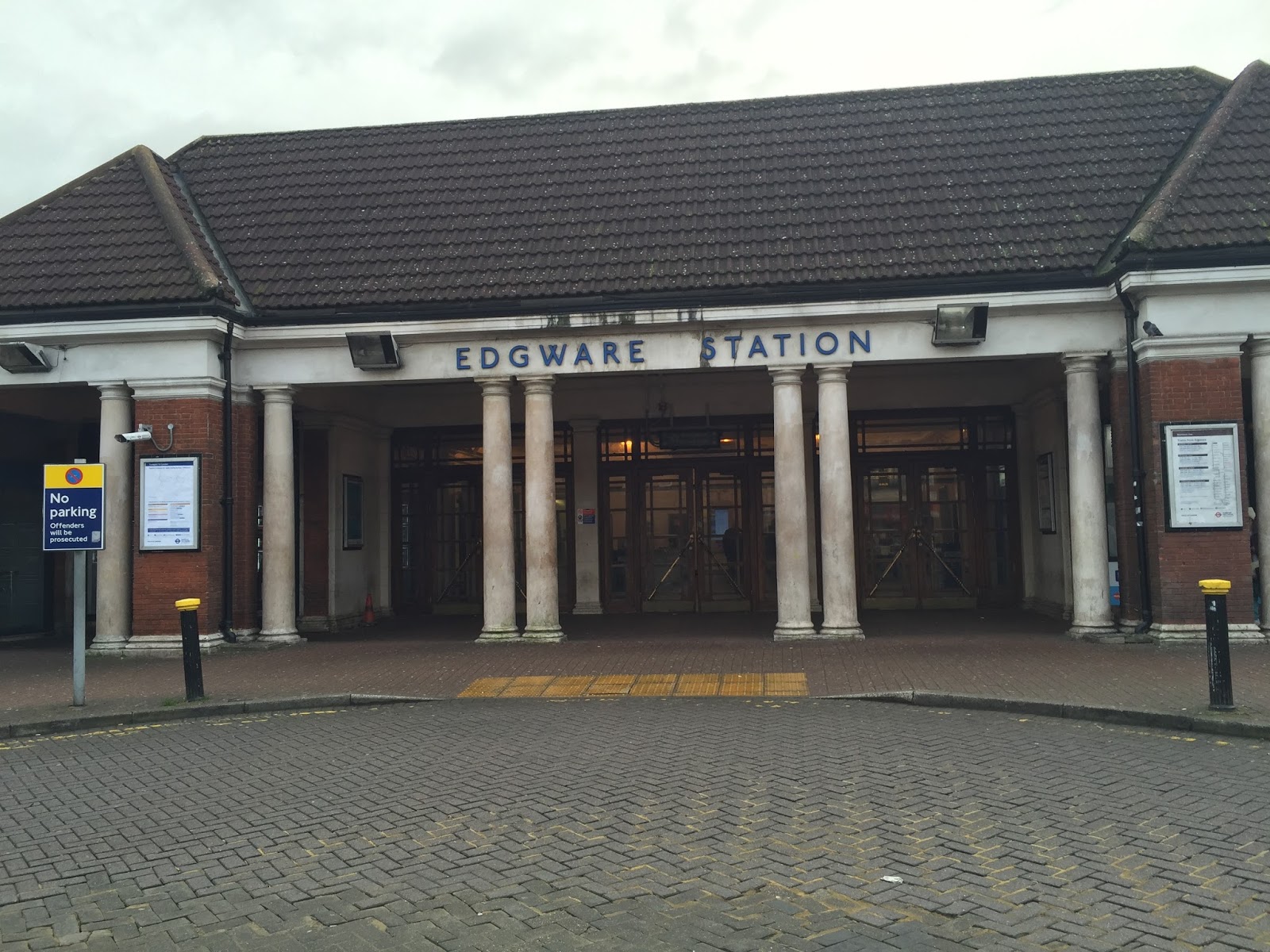
Edgware station entrance.


This is Edgware.

A short history of the Northern Line:
The Northern Line was created from three different companies in the 1920s. The Stockwell to Borough section is the oldest deep level tube section on the whole tube system opened in 1890.

The Northern line has various branches, which I discovered yesterday, There is the southernmost branch leading from Mordern to Waterloo. There are two central branches, one going via Bank Station and taking in the eastern part of the city and then there is the Charing Cross branch which includes the West End.The two northern most branches of the line split at Euston Station, one going to Edgware and one going to High Barnet.

The different sections of the line allude to the various railway companies that once owned the different parts of the Northern Line. The City and South London Railway Company, the C&SLR, began the original Stockwell line in 1890. The Charing Cross, Euston & Hampstead Railway, the CCE&HR, opened a line in 1903 from Charing Cross to Highgate.
In 1913 the Underground Electric Company of London, the UERL, who owned the CCE&HR took over the C&CLR but ran them as two separate lines. In 1920 a new tunnel was dug and the two lines were joined to make, The Northern Line.

At present there are plans to extend the Northern Line. from Kennington to Battersea. From recent negotiations between London Transport and the tube workers unions, mostly about safety for employees, pay and conditions, which has been long going and arduous,  a twenty four hour ,"Night Tube,"will run on Friday and Saturday nights from Edgware and High Barnet to Mordern via Charing Cross.

Between 2003 and 2010 the Northen Line was the busiest line on the system. It is now the second busiest line on the system.

The London Underground font:
This is the sign for Burnt Oak Station. Burnt Oak is the penultimate station on the Edgware branch of the Northern Line. The font used for the London Underground signs was developed especially  for London Underground by Edward Johnston in 1916. It is a modern, simple and fresh lettering.It is  as direct and clean cut as  when it was first introduced in 1916. Transport for London owns the design and copyrights for all cuts of the New Johnston font. Other versions of the font such as the Johnson Delf Smith typeface was developed for some historical signs.

What of the future?
The Northern Line provides a link between north and south London.It works at full capacity being one of the busiest tube links in London. Over the decades and centuries it has been in existence it has provided access for people to get to jobs within the city in the banking and insurance sectors and has provided links to the entertainment industries in the West End and also the retail sector centered on Oxford Street and Regents Street. Jobs, businesses,the creative sectors such as the arts, museums, theatres and concert halls , leisure and education have all been served by providing quick travel from north to south London. London is growing and expanding at an enormous rate. More jobs and more industries need to develop and grow. The present tube and transport network, being at full capacity, needs to be expanded and modernised to meet these 21st century demands. Crossrail has been recently completed from Heathrow in the west  to Canary Wharf in the  east. It is a fast, high volume and modern expansion to London's transport system. Crossrail 2, is now planned and in the process of being constructed from South London to North London to create a much more efficient and high capacity, "northern line." Here is the Transport for London's description of the benefits provided by these new and faster crossrail networks.

"The key transport aims for Crossrail will support delivery of the objectives set out in the May 2010 Mayor’s Transport Strategy, namely to: • Support sustainable economic development and population growth by increasing transport capacity, reducing congestion on the transport network; • Improve transport connectivity through journey time savings; and   • Bring wider benefits including: enhancing accessibility (including those with restricted mobility) thereby improving people’s access to jobs, schools and other locations; improved transport safety with reduced road accidents; and environmental improvements; including a reduction in C02 emissions; 2.3 Crossrail will also support the delivery of objectives set out in the DfT’s Business Plan, namely to: • Support a transport system that is an engine for economic growth but one that is also greener and safer and improves quality of life in our communities; • Improve the links that help to move goods and people around; • Secure the sustainability of the railway and create capacity for improvement of services, by addressing the high cost of the UK railway compared with other railways and comparable industries; continue to invest in Crossrail and London Underground upgrades in the capital. Supporting London’s growth and relieving congestion."

The old Northern Line has provided access for Londoners, north and south, in the past and the above is a good description of what The Northern line has provided until now but on a smaller scale. The new Crossrail is intended to carry these  benefits, at an increased rate, forward into the 21st century.